
Workshop: Finding Pathways for Human-Machine Teaming in Command and Control at operational level: Taking advantage of both the best humans can offer and machines can provide.
The aim of the workshop was to generate clear, actionable insights from the participants and to encourage discussion about how HMT is already changing their daily and professional lives. The outcomes will serve as the basis for further research.
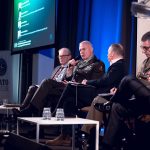
During the workshop-afternoon a research group consisting of LtCol Rabia Saylam, PhD (NATO C2COE) LtCol Gwendolyn Bakx, PhD (JAPCC), LtCol Ralph Dekker (NLD MOD) and Max van Rijn, MA BEd (NATO C2COE) presented their paper: “Finding Pathways for Human-Machine Teaming in Command and Control at the Operational Level: Taking advantage of both the best humans can offer and machines can provide”.
Rather than offering a prescriptive blueprint, the paper presents practical considerations and concrete, actionable suggestions for embedding Human-Machine Teaming as a foundational enabler across all features of Cross-Domain Command. Ultimately, Human-Machine Teaming offers not merely technological enhancement but a paradigm shift toward more adaptive, resilient, and effective command, leveraging both human judgment and machine capabilities in concert.

Setting the scene: Presenting the article
The research team first introduced the current state of the Cross-Domain Command. The main goal of CDC is to enhance the orchestration and synchronization of activities within Multi-Domain Operations. At the essence of NATO’s Cross-Domain Command Concept is rethinking how commanders lead, decide, and act across a complex and connected engagement space. It is dependent upon greater interoperability, standardization and immediate change impacting people, processes and technology to secure Decision Advantage.
The increasing speed, complexity, and multi-domain nature of modern military operations demand a transformation in how decisions are made and executed. This study serves as a follow-up to, and provides more detail on, NATO’s Cross-Domain Command by exploring how Human-Machine Teaming can be systematically integrated to achieve decision advantage. Building on socio-technical systems theory and lessons from high-reliability areas such as aviation, the study highlights how the cognitive collaboration between humans and AI-enabled systems is reshaping the Command and Control landscape.
This approach involves more than just technology; human-machine collaboration must be part of a full socio-technical system. The real advantage lies in improving command and decision-making, rather than simply automating old tasks. The research group calls this ‘True Teaming’: a dynamic where humans interpret, adapt, and stay in control, while machines learn, communicate, and adapt alongside them.
A deep operational understanding of how the socio-technical system functions under real-world constraints and pressures is essential. To achieve this, structured education and targeted training must be implemented for both humans and machines, specifically designed to embed effective learning design patterns. This training requires the use of realistic scenarios, moving beyond contained, perfect lab environments. Ultimately, system literacy must be viewed as continuous and evolving, serving as the crucial foundation for mutual trust and resilient teams.
The research group presented a list of seven considerations & solutions to get True HMT and cope with the risks, serving as the starting point for the interactive part of the workshop:
- Make sure HMT is not relegated to isolated components or retrofitted into legacy structures but becomes part of the overall socio-technical system
- Rethink traditional command hierarchies, allowing for fluid roles, changes of authority, and (dynamic) shifts in level of autonomy where appropriate
- Establish true human-machine teaming by promoting and enforcing co-adaptation, cognitive collaboration, and shared understandings:
- Enable machines to learn from human preferences and team dynamics
- Embed scenarios and collaborative interaction patterns that promote/enforce reciprocal learning (and trust) between human actors and machine agents
- Build critical system literacy on the whole socio-technical HMT system as an overarching operational mindset, equipping humans to interpret, supervise, and challenge machine outputs
- Training imperatives should deliberately cultivate HMT and be tailored to real-world settings (rather than ideal conditions)
- Design to prevent over-alignment and cognitive convergence through regular interval external (AI) calibration mechanisms and scenario divergence
- Counter the automation paradox: prevent human skill degradation by actively maintaining skills
The workshop setup
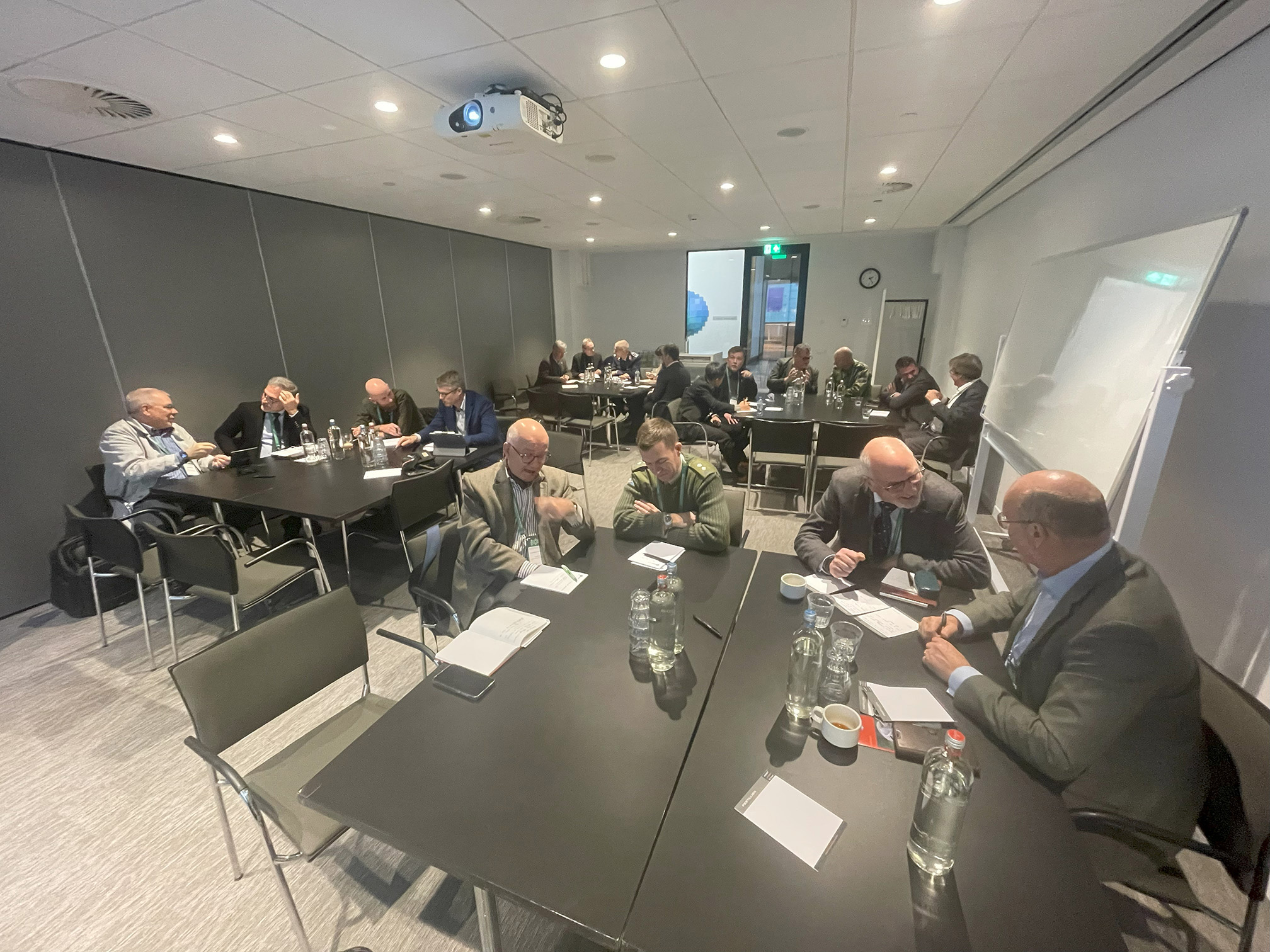
The setup of the workshop was based on discussion among the participants, who were set up in groups of 4 or 6. under a certain time pressure they were asked to come up, and discuss (first in pairs, then in a group) the following questions:
- What can you do tomorrow to get HMT working in CDC?
- Based on the presented Considerations & Solutions, What would you propose as practical pathways to follow?
- What considerations and solutions would you like to add to the already presented list?

Outcomes and takeaways
Participants consistently emphasized the need for a fundamental shift in human capabilities and organizational culture.
A full culture change and cognitive retraining are deemed necessary to adapt to the fast-evolving HMT integration. Education and Training are essential. Participants noted the necessity for training in system literacy, both formal and informal, to enhance understanding of the HMT socio-technical system. There’s a strong caution against the automation paradox (a risk already presented by the research group) where human skills degrade. Even as machines take over tasks, humans must actively retain their skills. An interesting counter-question was raised: “What is it exactly that humans can do better?”.
Building and managing trust between human operators and machine agents, along with establishing an ethical framework, were central to the discussions in both groups. Trust is essential and is only built up over time; it must be deliberately curated. Participants noted that current trust is the issue and that it need to be made or at least must feel trustworthy. Ethics must be addressed, and participants pondered the long-term impact on human brain capacity if AI is used for everything.
The need for Self-Awareness regarding AI use was highlighted. Practical suggestions included using historical checks/iterative checks to calibrate the AI and pre-programming how the AI should think. An epistemology of AI (clear understanding of what the AI knows and how it knows it) is required and thus needs to be incorporated into training.
A pathway for immediate action is to start immediately with HMT (and don’t wait for it to happen) and learn by doing and learning on the job every day. One suggestion was to read the concept, talk (and interpret) and share immediately.
To integrate and test HMT, groups must build and execute wargames that fully incorporate these new technologies and structures.
Participants proposed rethinking traditional Command and Control structures and moving from a clear task division to a performance-oriented division between humans and machines, supported by deliberate coordination mechanisms to ensure they operate as a coherent whole. This includes incorporating HMT into current missions and considering the changing speed of relevance, which became the speed a machine can operate.
This reflects a management effort in which distributed responsibilities must be deliberately re-coordinated to make sure that Human-Machine Teams function as an integrated socio-technical system rather than as fragmented components.

Final words
The research group would like to thank all participants for their positive attitude toward the subject and their openness during the discussion and invites everyone to continue these efforts by contacting the NATO C2COE at NATO.C2COE@mindef.nl. All contributions will help advance both the topic and ongoing research.
The article can be downloaded on the website of the NATO C2COE: https://c2coe.org/download/hmtarticle/